Reviewing Tool Step 3: Survey Planner
Supporting the Academic Skills Provision Toolkit
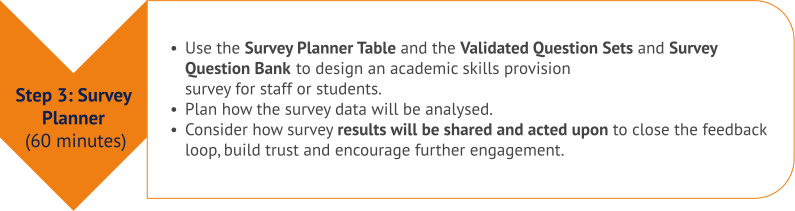
Step 3: Survey Planner (new image from designer to go here)
This Survey Planner is designed to support colleges to create student and staff surveys with the purpose of gathering feedback on college academic skills provision in order to inform any enhancements or changes to provision.
Colleges may wish to focus on an item identified as a priority as a result of completing the Self-Evaluation Checklist.
The Survey Planner comprises of:
- A blank Survey Planner Table to be completed by your college team
- An example of a completed Survey Planner Table.
It is supported by the Validated Question Sets in Appendix 1 and Survey Question Bank in Appendix 2.
10 tips for designing a survey
- Include a clear statement on confidentiality and anonymity so respondents know whether they will be identifiable.
- Ask the most important questions at the start of the survey.
- Ask questions that require sensitive or personal information at the end of the survey.
- Ask one question at a time, rather than including two questions together.
- Try to use scales – ideally giving at least five options – rather than giving only binary ‘yes/no’ or ‘agree/disagree’ response options.
- When using scales, assign verbal labels to each response option (rather than labelling with numbers only).
- Ensure that the visual appearance of the survey is consistent and accessible (eg scales spaced equally apart).
- Ask information that will help you to contextualise responses, for example, which subject the student studies, what year they are in, etc.
- Provide an incentive for respondents to complete the survey (eg a voucher or tickets to an event). This will require respondents to waver anonymity but is likely to yield a higher response rate.
- Close the feedback loop: tell respondents what you plan to do / have done with the survey data.
Survey planner table (blank)
|
Question |
Response |
|---|---|
|
What does your college want to find out about its academic skills provision and why? |
Enter your responses to the questions in this column |
|
What does academic skills provision currently look like in your college? |
|
|
Who do you need to survey? If you want to gather feedback from both staff and students, consider whether two separate surveys will be needed. |
|
|
How will you distribute the survey? |
|
|
Do you already have any data that will help you to design / interpret this survey? (quantitative or qualitative) |
|
|
What will be the incentive for students to engage with your survey? |
|
|
What questions do you want to ask students / tutors / colleagues in your survey? See the Validated Question Sets and Survey Question Bank for suggestions. You may find it helpful to list questions in the order in which you want to ask them. |
|
|
When will your survey take place? |
|
|
What will you do with your survey data? See the Survey Data Interpretation: A Quick Reference Guide in Appendix 3 for information. I DON'T THINK I HAVE THIS? |
|
|
How will you close the ‘feedback loop’? Consider how will you let students and staff know that you have responded to the evaluation data. |
|
Example of a completed Survey Planner Table: Reviewing provision for first-year undergraduates
|
Question |
Response |
|---|---|
|
What does your college want to find out about its academic skills provision and why? |
Having completed the self-evaluation checklist in a recent college meeting, we have identified prompts 2 (Current college academic skills provision meets different students’ needs) and 3 (Students have opportunities to engage flexibly in academic skills provision) as our priorities. We consulted the A Guide to Reviewing Academic Skills Provision in Colleges which indicated that designing a survey using this tool could help us to review these two issues. Specifically, we want to know if our academic skills provision meets the needs of first-year undergraduates because very few of them engage with our provision. We are also wondering if there are ways we could make our provision more flexible to ensure there are no barriers first-year students are experiencing that are preventing them from engaging with provision. |
|
What does academic skills provision currently look like in your college? |
Existing provision for first-year undergraduates (in addition to support provided by subject tutors in tutorials) includes:
|
|
What are the expected benefits and outcomes of this survey? These should include ‘change’ words, such as ‘increase’, ‘improve’, etc. |
Expected benefits include:
|
|
Who do you need to survey? If you want to gather feedback from both staff and students, consider whether two separate surveys will be needed. |
We will need to create three separate surveys. |
|
How will you distribute the survey? |
We will create the questionnaires in Microsoft Forms and email the link to tutors’ and students’ university email addresses. We will ask personal tutors to encourage students to complete the survey. The emails will be sent by the Senior Tutor. |
|
Do you already have any data that will help you to design / interpret this survey? (quantitative or qualitative) |
We have standard data that we collect:
We will need to review these data as there may be important trends, for example, are undergraduates from some subjects engaging more than those from other subjects? |
|
What will be the incentive for students to engage with your survey? |
As an incentive for students to complete the survey, we will enter participants into a prize draw with several prizes to win £50 on their college card, which they can use to pay for meals including formal dinners. Students will have the option to remain anonymous if they do not wish to be entered into the prize draw. Surveys will be short (no more than 10 questions) to encourage completion. |
|
What questions do you want to ask students / tutors / colleagues in your survey? |
See the Survey Question Bank for suggestions. You may find it helpful to list questions in the order in which you want to ask them. |
|
When will your survey take place? |
Start of Hilary term would be a good time because by that point first-year students have already had one term at Oxford and so will have some idea of the type of academic skills support that would be beneficial. Second-year students will also still be able to recall first year and their experience of University exams (eg moderations / prelims). The survey will be sent out on Tuesday of Week 1, and a second time as a reminder in Week 2. It will close on Tuesday of Week 3. This won’t give us much time to make any changes this academic year, but we could use Trinity term to plan for the next academic year, including how we will evaluate any changes we make. |
|
What will you do with your survey data? See the Survey Data Interpretation: A Quick Reference Guide in Appendix 3 for more information. I DON'T SEEM TO HAVE THIS? |
We will compile the data in a report to go to our Academic Committee for comment in Week 6 of Hilary term. We need to use this meeting to discuss any changes we would like to make to our academic skills provision as a result of the survey data. Some of these changes might be quick (eg more advertising of provision available), whereas others might require more long-term planning (eg if we decide we need to completely restructure academic skills provision in our college). |
|
How will you close the ‘feedback loop’? Consider how will you let students and staff know that you have responded to the evaluation data. |
After Academic Committee meet in Hilary term/Trinity term to decide on next steps based on the data gathered, we will likely need to form a small working group to implement the changes. We should contact all students to inform them at various stages of this work (rather than just communicating at the end). This will include making a summary of the report available to students and letting them know what we a) are planning to do in response and b) have done in response to the survey data. |
Adapted from Imperial College London’s guidance on survey design.

Contact us
If you have a query, please contact us at
Stay informed